
Joe Simpson and Simon Yates were the first to climb the west face of Siula Grande, a peak of more than twenty thousand feet in the Peruvian Andes. It was 1985, and the way down nearly killed them both.
On the descent they ran out of food and fuel for the stove. Then Simpson fell off an ice cliff, a sudden drop in the slope, and landed badly. His shinbone was driven up into his knee. He could stand on one leg. He could not walk.
At that height and that distance from help, a broken leg usually means you stay on the mountain.
Yates decided to lower him off it.
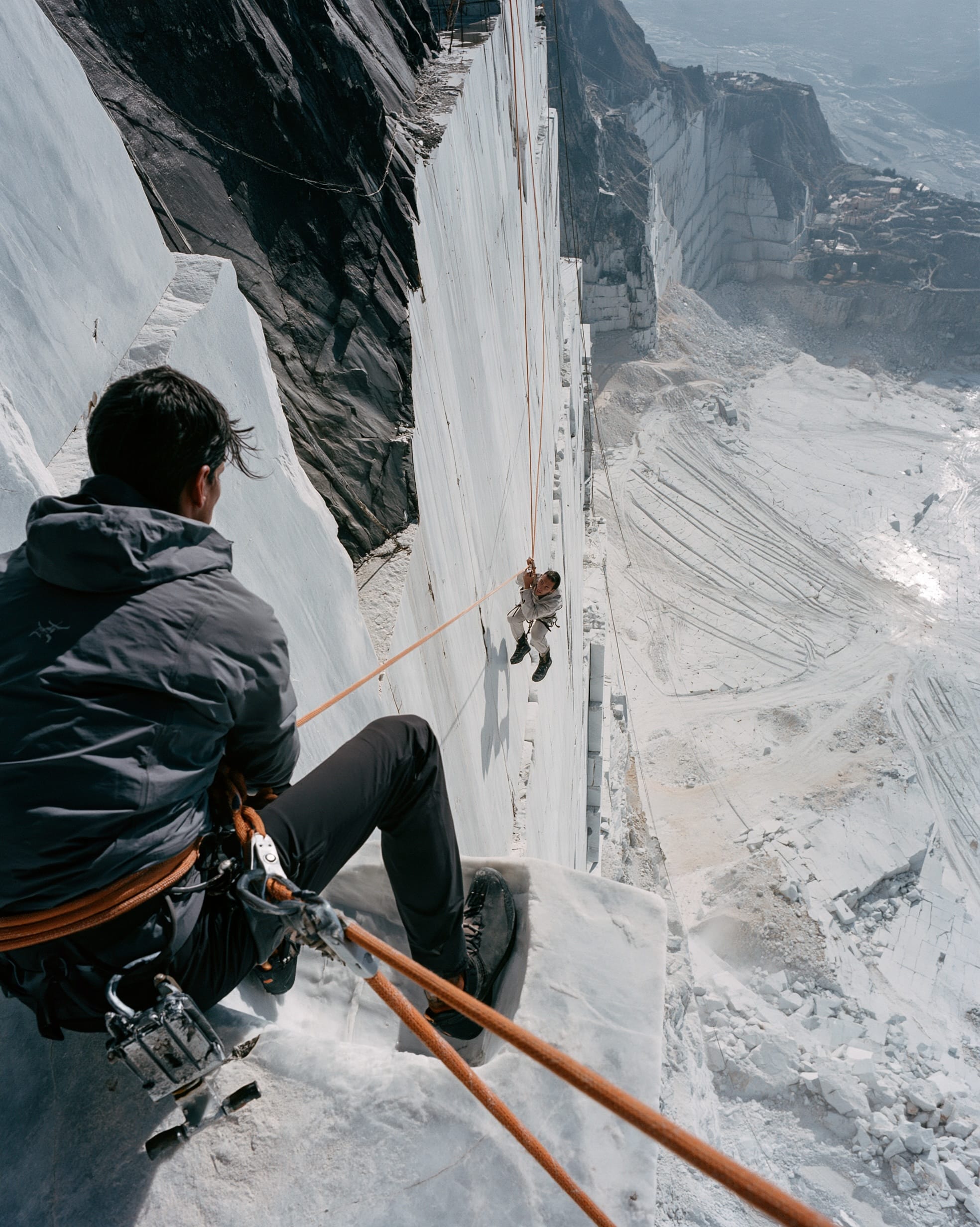
There was nothing to tie the rope to. No rock, no tree, nothing solid under the snow. So Yates scooped a seat out of the slope and sat in it with his legs braced in front of him. His body, wedged in the snow, was the anchor. If the seat gave way, he would be pulled off the mountain too.
They had two ropes of about 150 feet each, knotted together. Yates fed the rope through a braking device on his harness and let Simpson slide over the snow below him.
Halfway, the knot reached the device and stuck. Simpson had to stand on his good leg and take his weight off the rope while Yates passed it through. At the full 300 feet, Simpson waited while Yates climbed down to him, dug a new seat and started again.
Through a storm, they descended about three thousand feet that way.
After dark, Yates lowered him over an edge neither of them could see. The slope below Simpson ended at a cliff of ice, and he slid off it. Instead of lying on snow, he was hanging in the air beneath an overhang, out of reach of the wall.
The knot had reached Yates's device again. With Simpson hanging free, nobody could take the weight off the rope. Yates could not lower him further, and he could not haul him up. Simpson tried to climb the rope with loops of cord that grip it, but his frostbitten fingers dropped one.
In the wind and the dark, 150 feet apart with an edge between them, neither man could see or hear the other.
Yates held him like that for more than an hour and a half. The snow under his seat began to crumble, and he was being dragged, a little at a time, towards the drop.
If he held on, they would both go.
He took out a pocketknife and cut the rope.
Below Simpson was a crevasse, a deep crack in the glacier hidden under a crust of snow. He fell through the crust and landed on a ledge inside it.
In the morning Yates reached the foot of the cliff, saw the crevasse and called into it. Nothing. He went on alone, sure his friend was dead.
He was not. Simpson lowered himself deeper into the crevasse on the rope he had left, found a slope of snow rising towards daylight, and pulled himself out onto the glacier.
Base camp was about five miles away, across more crevasses and then the moraine, a field of loose boulders the glacier had dumped. He had a broken leg, no food and almost no water.
Five miles was impossible. So he stopped thinking about five miles.
A voice in his head, he wrote later, took charge. It picked a point ahead, a rock or a ridge of boulders, and told him how long he had to reach it. When he got there, it picked the next.
For a while he followed Yates's footprints in the snow. Then fresh snow covered them, and the voice was all he had.
He crawled. He hopped, using his ice axes as crutches. He drifted in and out of delirium with a Boney M song stuck on a loop, and at one point thought, "Bloody hell, I'm going to die to Boney M."
He did not. Three days after climbing out of the crevasse, he crawled into the edge of camp in the dark. Yates and Richard Hawking, who had been minding the tents, were due to leave in the morning.
The whole distance would have stopped him. The next rock never did.
TOO BIG TO LOOK AT
Every long, hard thing reaches a point where the goal feels too big to face whole.
The surgeon says the knee will take nine months.
The house needs rebuilding one room at a time, and you are still on the first room.
The debt will take four years to clear.
Mile sixteen of a marathon, with ten still to go.
The total makes the next step look pointless. One rehab session against nine months. One payment against four years. One mile against ten. Set beside the total, the step looks as if it does not matter.
So it gets skipped. And the whole thing gets longer.
That is how you come to feel like giving up on something you are perfectly able to finish.
THE SIZE OF THE JOB DRAINS THE NEXT STEP.

Effort changes when the finish is close. Researchers tracked a campus coffee shop that gave a free coffee for every ten stamps on a card. As customers got nearer the free one, they came back sooner, about twenty percent sooner by the last stamp than the first.
A second version of the card asked for twelve stamps but arrived with two already filled in. The work was identical: ten more coffees. Those customers finished in a median of ten days. The plain card took fifteen.
Nothing changed except how close the finish looked.
That is the real reason to break a big goal into smaller goals. Each one puts a finish near enough to keep you going.
Five miles of glacier is never close. A rock fifty yards away is close from the moment you choose it.
This content is only available to subscribers
Subscribe now and have access to all our stories, enjoy exclusive content and stay up to date with constant updates.
Unlock contentAlready have an account? Sign In